

SAP Business AI
SAP Business AI
in Manufacturing and Wholesale
SAP is integrating AI more deeply into business processes and applications. But which opportunities are relevant to your organization? Where does AI actually add value? And which process is the best place to start?
Quinso helps organizations in the manufacturing and wholesale sectors translate SAP Business AI into concrete applications in finance, production, and logistics. It’s not about AI for AI’s sake, but rather applications that help employees gain insights more quickly, identify risks earlier, and determine better-informed next steps.
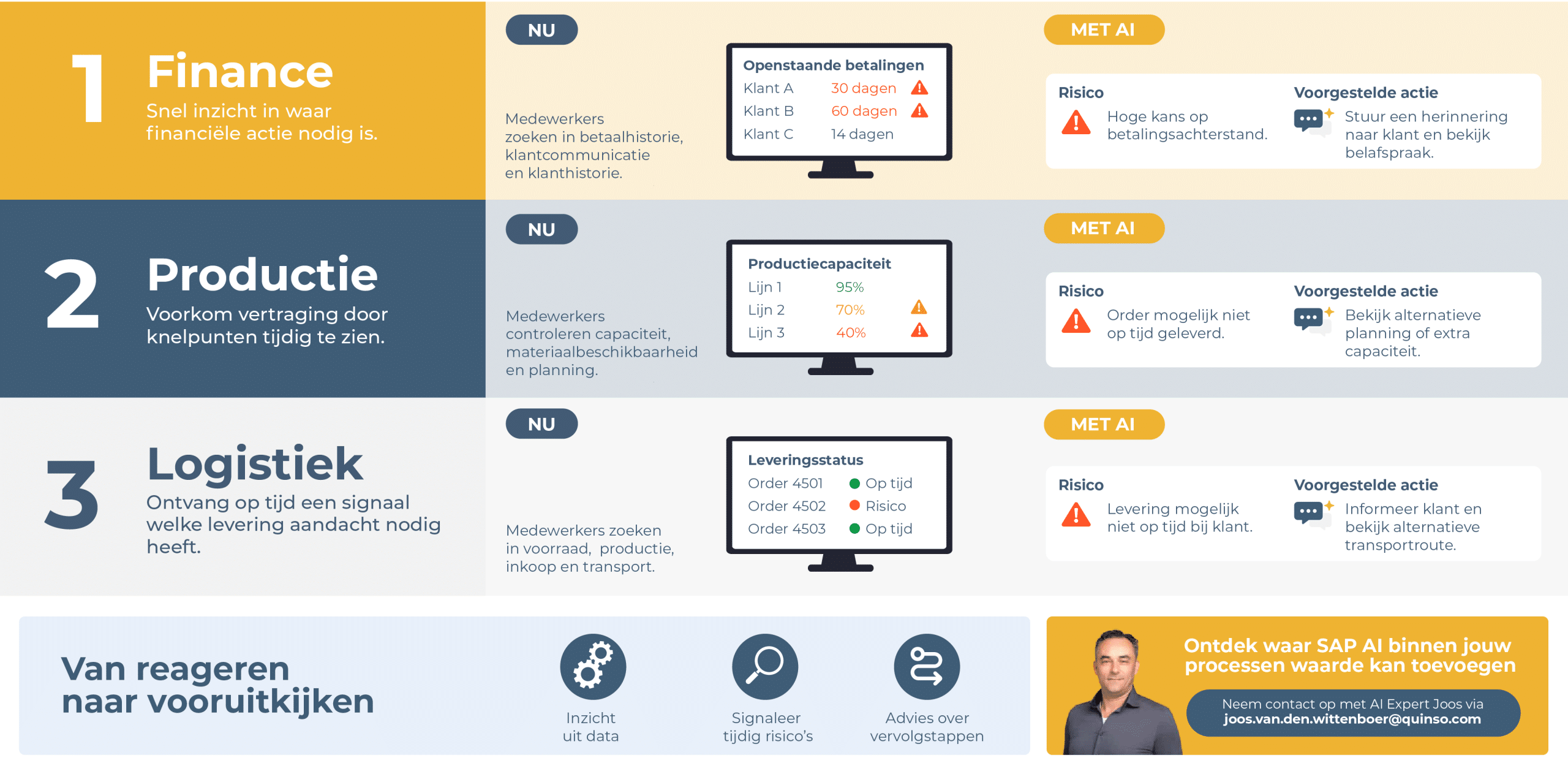
In many organizations, employees still spend a lot of time searching, verifying, and reconciling data. SAP Business AI can consolidate information from various processes, identify discrepancies and risks earlier, and suggest possible next steps. As a result, the focus shifts from searching and reacting after the fact to earlier detection, assessment, and course correction.
This can lead, for example, to higher productivity, faster decision-making, less manual work, and better control over exceptions and disruptions. Employees continue to play an important role in this process: AI provides support through information, analysis, and recommendations, while people determine the appropriate course of action.
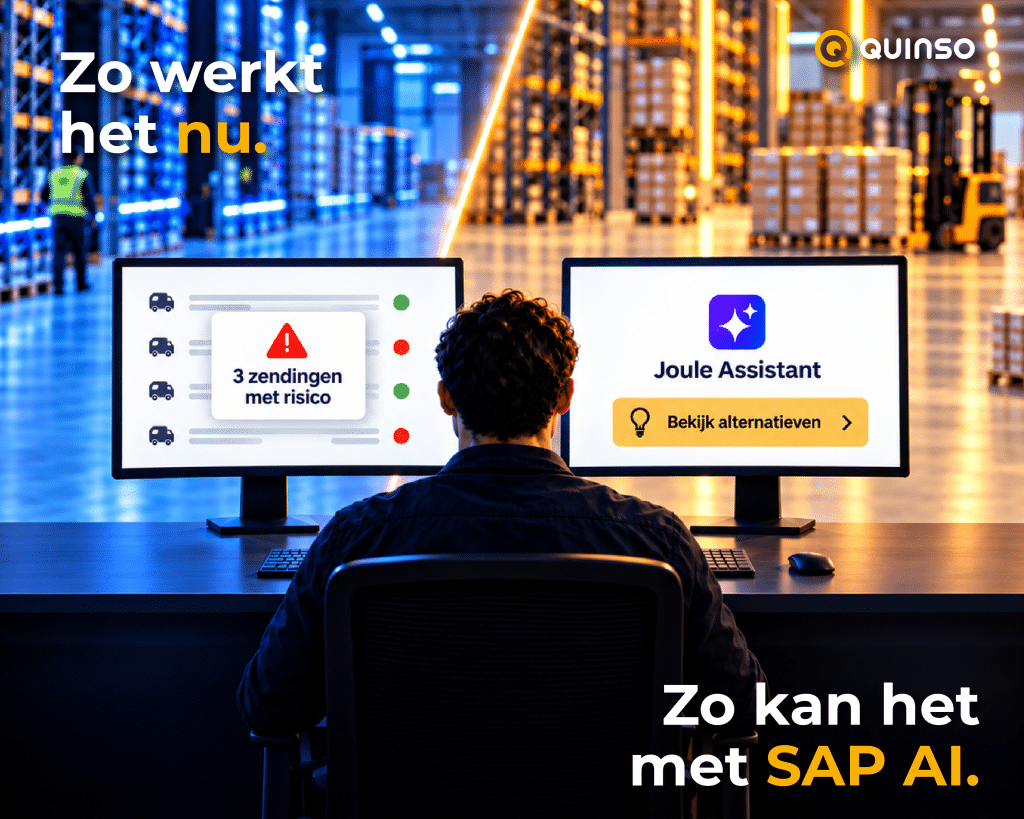
This is how it works now. This is what’s possible with AI.
Many organizations have plenty of data. The challenge is that information is scattered across systems, documents, and email, and employees have to decide for themselves what requires attention. That takes time and increases the risk of errors. Data quality, context, and good governance are therefore essential for AI to actually deliver value.
Which situation sounds familiar to you? Start with a single process in which employees search, check, and make decisions over and over again every day. Check out our opportunity map to see where opportunities lie within your organization.
What is SAP Business AI?
SAP Business AI is SAP’s overarching AI approach. AI is integrated into SAP applications, business data, and processes.
So it’s not just about a chatbot operating alongside the business process. AI can help employees find and summarize information, analyze business data, identify anomalies, and prepare next steps.
SAP Joule serves as a key entry point for users. Employees can ask questions in plain language and receive support within their own work environment.
The Future of SAP Business AI
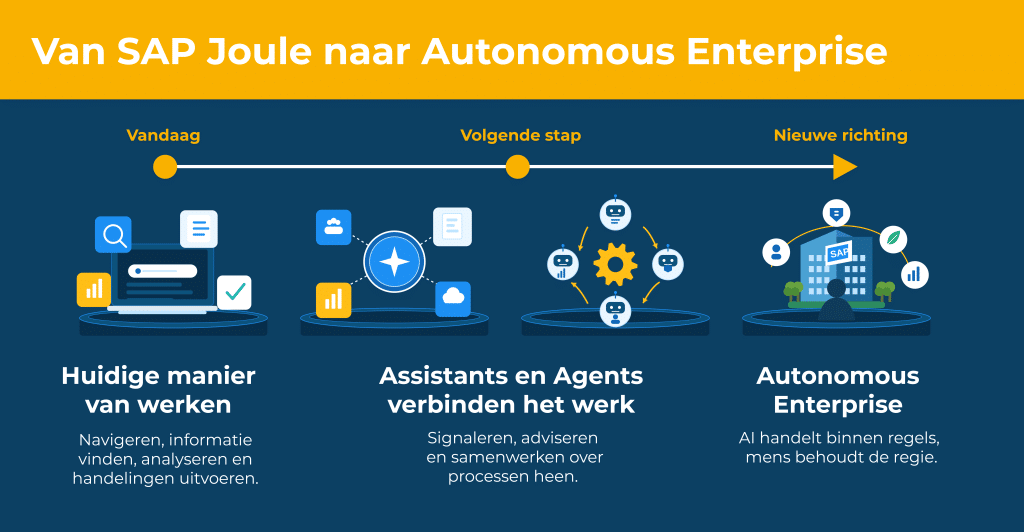
SAP Business AI is evolving rapidly. While SAP Joule began as an AI assistant that answers questions, it is now growing into a smart support system for entire business processes. With the introduction of Joule Assistants and Joule Agents, SAP is taking steps toward the Autonomous Enterprise: an organization in which AI increasingly supports and performs tasks independently.
But what does this development mean, specifically, for your organization? What can SAP Joule already do today? What developments are on the horizon? What does this mean for your employees? Where do you start?
Our SAP AI Expert, Joos van den Wittenboer, will walk you through the current capabilities, future developments, and opportunities for your organization.
How does SAP Business AI come together in a single platform?
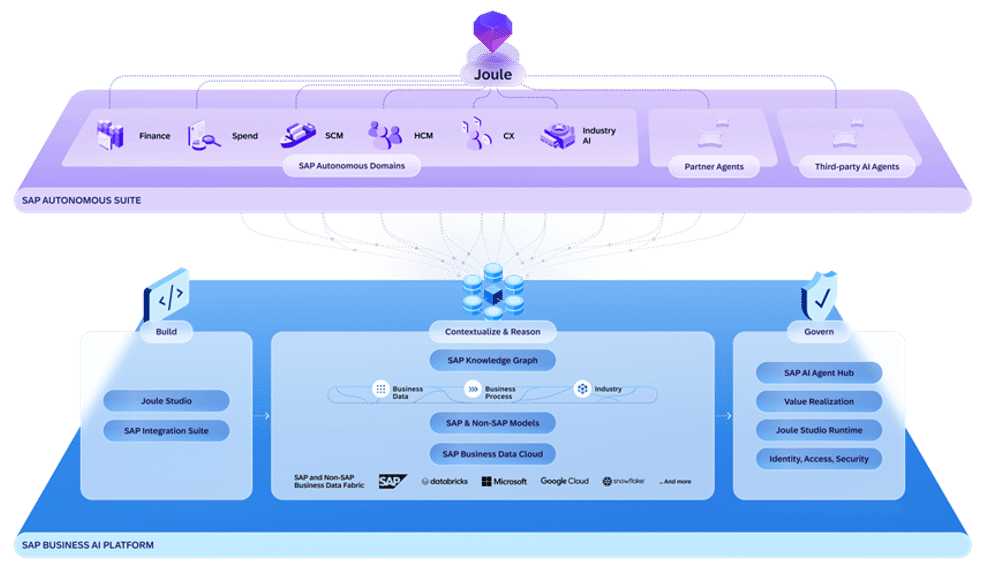
Joule, AI agents, business data, and your SAP processes are not separate from one another. It is precisely this interconnectedness that determines what SAP Business AI can mean for your organization.
In 6 practical insights, SAP AI expert Joos van den Wittenboer uses the SAP Business AI Platform to explain how these components are interconnected and what this means in concrete terms for organizations in manufacturing and wholesale.
A good AI application doesn’t start with technology
AI is only interesting if it solves a specific problem. Think of employees who spend a lot of time on checks, information scattered across different systems, exceptions that must be assessed manually, or disruptions that can’t be addressed until it’s too late.
That’s why we don’t start by looking at what AI is technically capable of. We start with the process.
Where does work take up unnecessary time? Where do errors or delays occur? Where could better information help make decisions faster?
Next, we’ll explore which SAP Business AI capabilities are suitable for this, what data is needed, and how you can get started in a manageable way.
Not every process is automatically suitable for AI. A promising initial application has a clearly defined problem, sufficient relevant data, and a result that can be made measurable.
- Choose a specific process problem
Where is a lot of time being wasted, or where do errors, exceptions, or delays occur? - Determine the potential value
What needs to be improved? Consider factors such as time, quality, inventory, delivery reliability, or administrative work. - Examine the data and SAP landscape
What information is available, and where is it located? - Determine the roles of AI and employees
What can AI support, and where is human judgment still necessary? - Start small and measure the results
Begin with a well-defined application and expand only once the value is clear.
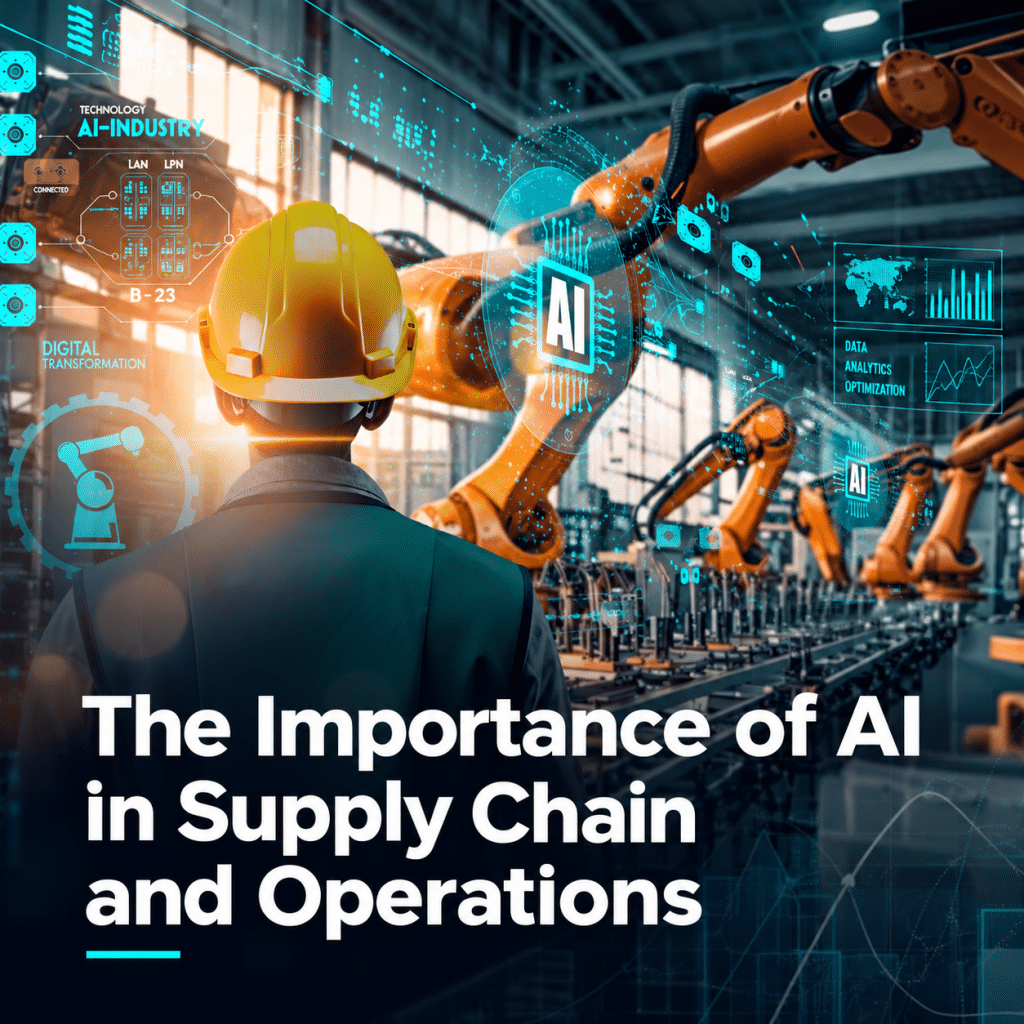
AI in Industry: From Buzzword to Impact
AI only becomes interesting when it solves a specific problem in your process. Think of detecting anomalies in production earlier, forecasting demand more accurately, responding more quickly to logistical disruptions, or supporting employees in their decision-making.
The impact varies by application. High-quality data, well-defined processes, and clear agreements on the use of AI largely determine the outcome.
In our blog, you can read about where the opportunities lie for industrial organizations, which applications are already relevant, and what it takes to move from experimentation to demonstrable value.
Benefits of SAP AI for Manufacturing and Wholesale
In a series of short videos, Joos van den Wittenboer, an AI expert, explains the benefits of SAP Business AI for your organization, drawing directly on his own experience and real-world examples from our clients.