
AI is everywhere. You read about it in the media, hear about it at conferences, and perhaps your organization has already started experimenting with it. But what does artificial intelligence really mean for companies in manufacturing and wholesale? How do you turn it from a buzzword into a tangible benefit on the job?
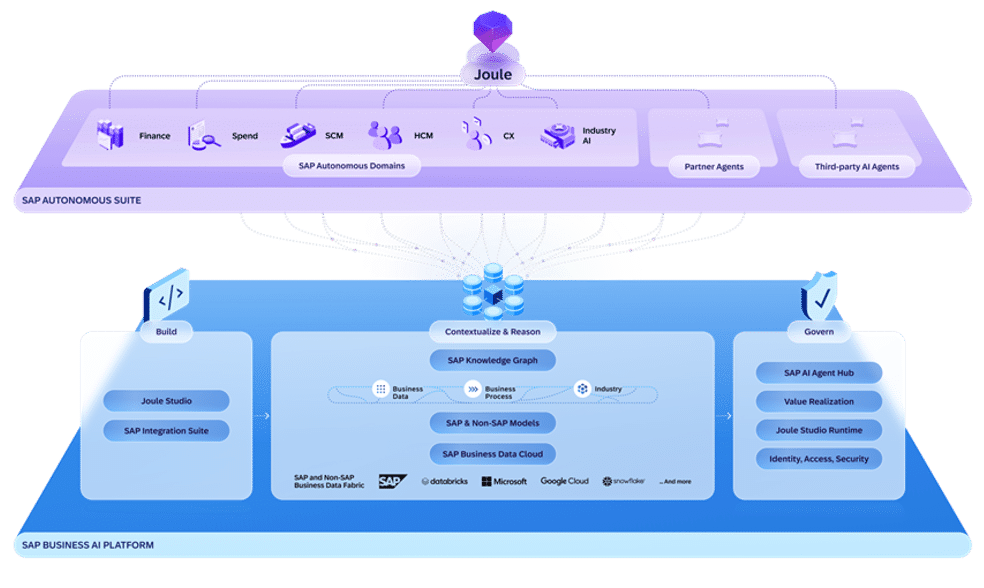
To clarify this, we’ll use a clear visual representation of the SAP Business AI Platform. A diagram that shows at a glance how AI, data, and processes come together. Joos van den Wittenboer, Principal SAP Consultant and SAP AI expert at Quinso, considers this diagram one of the best ways to explain the application of AI. In his role, he helps organizations in the manufacturing and wholesale sectors with strategy and digital transformation, and he has a clear vision of how AI can already add value for businesses.
In this blog, we sit down with Joos. In a series of questions and answers, he explains step by step what lies behind this visual and what it specifically means for operational, financial, and IT managers. His insights make it clear why now is precisely the time to explore AI and how we at Quinso can support you in that process.
Question 1: Joos, what exactly do you see in this image, and why is that relevant to managers in manufacturing and wholesale?
Joos: “You can see how the SAP Business AI Platform is truly a single, integrated platform.”
At the top is Joule as the user interface. Just below it on the left are the SAP applications—ranging from supply chain and finance to HR and spend management—in which AI capabilities are embedded depending on the solution and scenario. This is complemented by agents that perform analyses and authorized process steps. Below that, in the center, you’ll see the SAP Business Data Cloud, which makes managed SAP and external data available for analytics and AI while preserving the business context. In the center, the SAP Knowledge Graph functions as a smart bridge that connects data and processes from the SAP Autonomous Suite, ensuring that AI also understands the SAP context.
“For managers, this means one thing: AI that is deeply embedded in processes, from the shop floor to the boardroom, without fragmenting your organization and data.”
Question 2: How do Joule Agents make a difference in day-to-day practice?
Joos: “Automating standardized processes has been possible for some time now, but agents make it possible to handle exceptions in a structured way as well. Imagine the finance and logistics teams collaborating on a case such as a payment dispute. Using existing or customer-specific agents and the growing library of thousands of Joule Skills, you can analyze and execute supported process steps. They can collaborate across functions and systems, allowing certain process steps to be executed more quickly.”
“That collaboration across regional, departmental, and system boundaries—that’s what makes Joule truly unique.”
Question 3: Why is the Business Data Cloud so important for AI?
Joos: “Many companies have data scattered across countless systems—both SAP and non-SAP—often involving replication or extraction. SAP Business Data Cloud unlocks SAP and external data through managed, clear, ready-to-use data and supports zero-copy access where appropriate. This enables the creation of a consistent, context-rich database for analytics and AI, provided that integration, data quality, and governance are properly configured. Joule distinguishes itself primarily by enabling answers and actions to be based on authorized business data, SAP semantics, and process context. Depending on the application, external sources can also be utilized.”
Question 4: What does the Knowledge Graph add to this?
Joos: “Data without context remains just isolated data. The SAP Knowledge Graph adds that missing layer by showing how data and processes are interconnected. This enables AI to recognize relevant connections and better base its answers or suggested actions on the context of the business process. If you ask SAP Business AI why the delivery to customer X is delayed, the AI can use the SAP Knowledge Graph to establish relevant connections between sales, current inventory, production planning, distribution, and relevant external factors.”
Question 5: What specific use cases do you see for industry and wholesale?
Joos: “You could think of things like…”
- Finance and Working Capital Agents can analyze open items and other financial data, propose solutions, and take follow-up actions within supported, authorized scenarios.
- Supply chain, planning, and manufacturing agents can assist users with disruptions, maintenance, and production planning. Availability varies by solution, edition, release, and license. This can help reduce downtime, but cannot eliminate it entirely.
- Sales and procurement agents: for example, automatically converting requests for quotes into ready-to-use quotes, or smart purchasing recommendations that lead to better decisions faster.
“Features like these not only make your organization smarter, but also add immediate value.”
Question 6: Can my organization implement this on its own in a customized way?
Joos: “Absolutely! With Joule Studio, you and your team can develop your own agents, applications, and workflows, allowing you to implement AI tailored to your needs. This doesn’t require extensive machine learning knowledge, but it does require an understanding of your processes, integration, and secure data access. Start with small, measurable use cases and scale up once it works and demonstrates value.”
We invite you to embark on this adventure
AI is no longer confined to silos but is integrated into the processes that keep your organization running. The combination of Joule Studio, Business Data Cloud, Knowledge Graph, and SAP Applications makes it possible not only to digitize processes but also to make them truly smarter. Depending on the application, the SAP Business AI Platform can summarize information, detect anomalies, make predictions, recommend next steps, or execute authorized process actions. The appropriate level of autonomy depends on the process, the quality of the data, the risks involved, and the human oversight in place.
Would you like to see how daily processes work now and how they can be optimized with the SAP Business AI Platform? Sign up for our digital masterclass, “How It Works Now. How It Can Work with AI.” Using familiar scenarios from manufacturing and wholesale, you’ll discover where the first promising applications lie and what it takes to get started responsibly.