

Your goods are ready for shipment, but the truck hasn’t arrived yet. The scheduled pickup time has changed, but no one has notified the warehouse. The opposite can also happen: the driver is waiting at the loading dock while the last orders still need to be picked.
For some manufacturing companies and wholesalers, this is a familiar situation. The warehouse and transportation planning departments don’t always have access to the same information. Employees then have to call or email to check whether a shipment is ready. As the number of orders grows, this takes more and more time. How can you better organize this handoff?

Two planning processes that depend on each other
In the warehouse, orders are picked and prepared for shipment. The transportation department needs to know when those goods will be available and when a carrier can come to pick them up. The warehouse, in turn, needs information about scheduled pickup times and any changes to those times.
Suppose a wholesaler delivers to customers in different regions every day. The transportation planner schedules a truck for orders that the system indicates are ready. However, it turns out that an item is not available in the warehouse. If that change isn’t communicated, the driver arrives to pick up a shipment that isn’t yet complete. The same situation can arise at a manufacturing company if finished products become available later than expected.
Manual coordination works—until things get busier
In logistics operations with straightforward processes, communication channels are often short. The warehouse employee knows the transportation planner, and any changes are communicated by phone. As soon as more orders and carriers are involved, it becomes more difficult to keep everyone informed in a timely manner. A change known to one employee does not automatically appear in a colleague’s overview.
That’s why it helps to clearly agree in advance when a shipment is considered ready and how a change in pickup time will be handled. This makes the collaboration less dependent on ad-hoc messages and individual employees.
Start with the handoff between the two processes
At Quinso, we work with the relevant employees to determine what information is transferred and when. Does the transportation department receive a “ready” notification as soon as the order is complete? Can the warehouse see that the carrier will be arriving later? We examine the workflow on the shop floor and the systems where that information is stored.
A good starting point is the “ready for shipment” status of shipments. When the warehouse marks an order as ready, it must be clear exactly what is actually ready for transport. The transportation planner can then better determine whether the scheduled pickup time is feasible. Changes from the transportation side must also be communicated back to the warehouse in a timely manner.
A good starting point is the “ready for shipment” status of shipments. When the warehouse marks an order as ready, it must be clear exactly what is actually ready for transport. The transportation planner can then better determine whether the scheduled pickup time is feasible. Changes from the transportation side must also be communicated back to the warehouse in a timely manner.
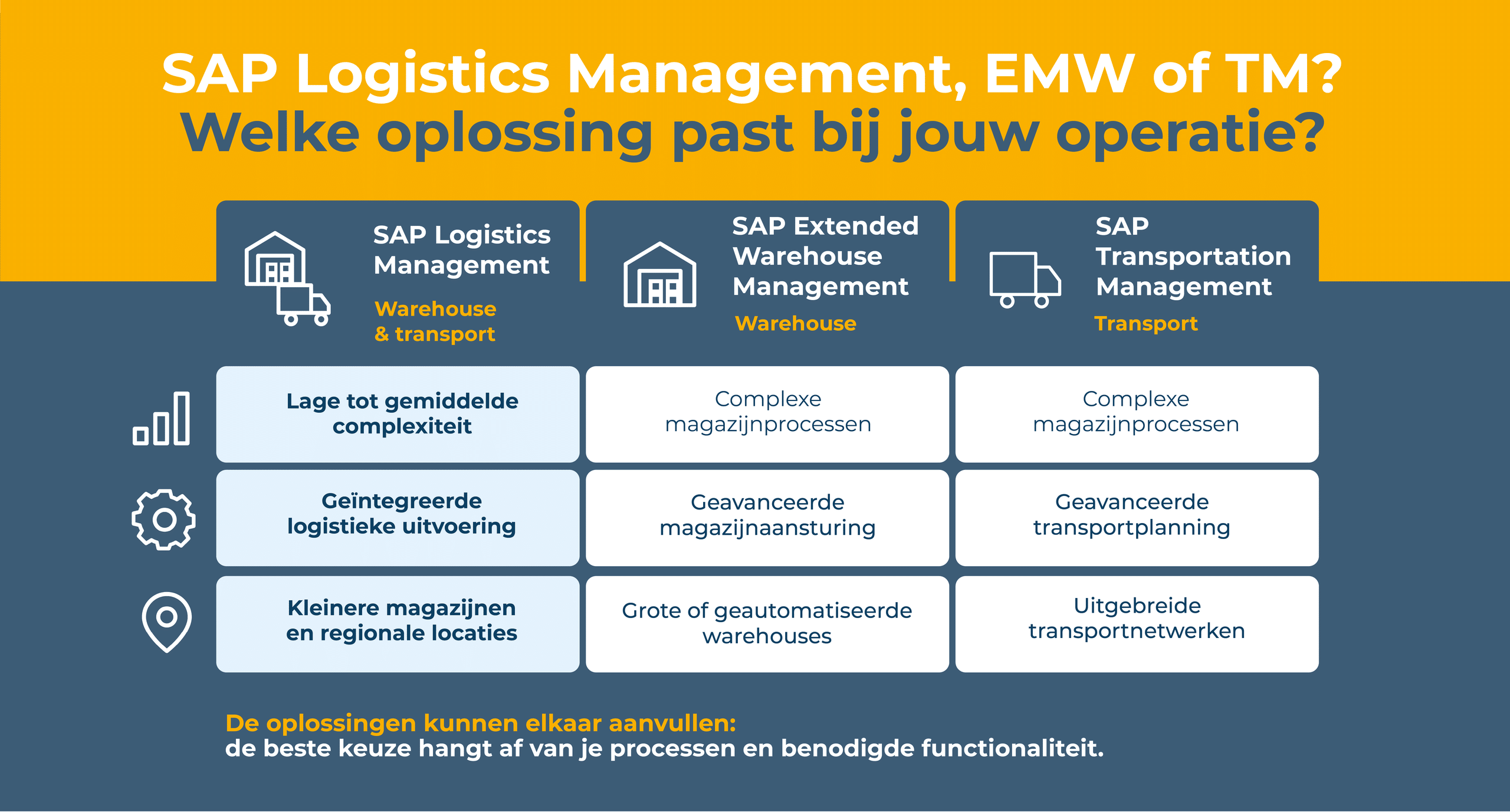
What does SAP Logistics Management add?
SAP Logistics Management is a cloud solution that supports warehouse operations and transportation activities. Among other things, the solution offers digital warehouse tasks and the processing of transportation requests and planning. This allows you to better align the progress of warehouse operations with transportation planning, within the capabilities of the chosen process and configuration.
Consider a regional distribution center where employees prepare orders that are picked up daily by carriers. With structured tracking of warehouse activities and related shipping information, employees can see sooner whether a shipment is ready and whether the schedule needs to be adjusted. SAP Logistics Management also offers options for collaboration with carriers. The information shared depends on the chosen configuration and integrations.
For more complex warehouse processes, SAP EWM is a better fit. For comprehensive transportation optimization, SAP TM may be necessary. In this article, we explain these different areas of application.
At Quinso, we take a holistic view of the entire flow of goods and help determine which solution fits best with your existing systems.
Less reliance on manual transfers
When the status of a shipment is known in a timely manner, the transportation team can plan for delays in the warehouse sooner. Employees don’t have to call as often to chase down information. The first step toward improvement, therefore, starts with determining what status information to share and who needs to be able to act on it.
This article concludes our series on SAP Logistics Management. In previous articles, we discussed the digitization of secondary warehouses and selecting an appropriate warehouse management system.
See also: Your central warehouse is fully digitized. But what about your secondary locations?