

Understanding and effectively controlling the shopfloor is a challenge in any manufacturing company. For Meteor Systems this is especially true. With seven production departments, each with its own manufacturing process from starting material to finished product, each department has its own requirements and thus its own definition of success.
That complexity called for more control over production orders. Therefore, the need arose for an MES platform behind the existing SAP S/4HANA system. Meteor Systems chose Quinso-developed QMES (Quinso Manufacturing Execution System), built on SAP BTP.
Phased improvement without production downtime
In less than two years, six production departments have now successfully gone live on the QMES platform. In the process, production never stood still. Only a few hours of logistics were lost.
“The horticultural industry in which we work is characterized by a very high level of tackling and just doing. Very few agreements are usually written down. As an IT department, however, we have learned that some structure and agreements are necessary to quickly establish a robust solution. My role consists of clarifying the goal and naming preconditions. The added value of our partner Quinso lies mainly in their commitment to make IT fit in the simplest and most robust way possible with how the business process really goes. They challenge us, making us feel understood,” says Stefan Cornelisse, Director Engineering & IT at Meteor Systems.
New functionality was added with each go-live. Thus, the solution was expanded and refined step by step, always tailored to the department’s specific process.
Per department solution that fits the process
Because each production department at Meteor Systems has its own process and dynamics, QMES is set up differently for each department.
Wire bending
The team leader makes fine planning of orders. Drawings are available digitally at the machine. Yield can be reported per box, including the last box with the remainder of the order. Pallets are reported with information from the scale. Once a pallet is reported, collection tasks are automatically created for logistics.
Extrusion
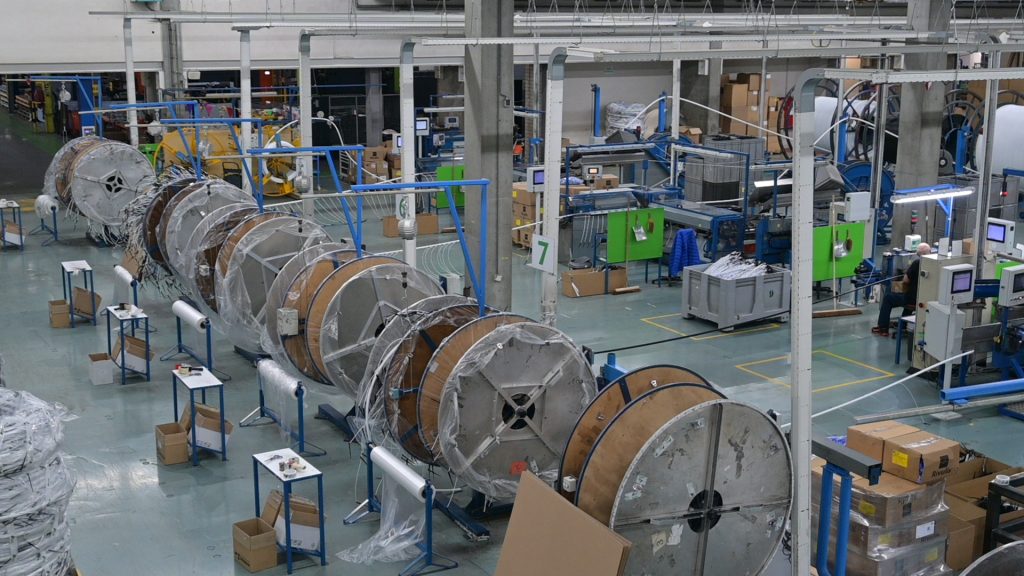
The yield of large reels of irrigation hose can be reported without using a pallet scale.
Injection molding
The team leader determines whether the yield is reported to the production floor for immediate consumption or to the warehouse for pickup.
Sheet Metal
Orders with multiple labor stages can be fully completed. Multiple orders can be active simultaneously at different stages of completion. Batch-managed sheet metal is automatically backflushed. Subcontracted work, such as galvanizing and powder coating, can also be reported ready.
Irrigation and Assembly
Orders can be distributed to multiple machines. A leak test is automatically enforced after a set interval or at a reel change. Units can be converted from meter to piece. The length of the last reel is calculated based on VC characteristics. Pallet data is retrieved via a scale, including length, width and height, as overhang may occur. Employees sign in with an RFID tag.
Tube rail systems
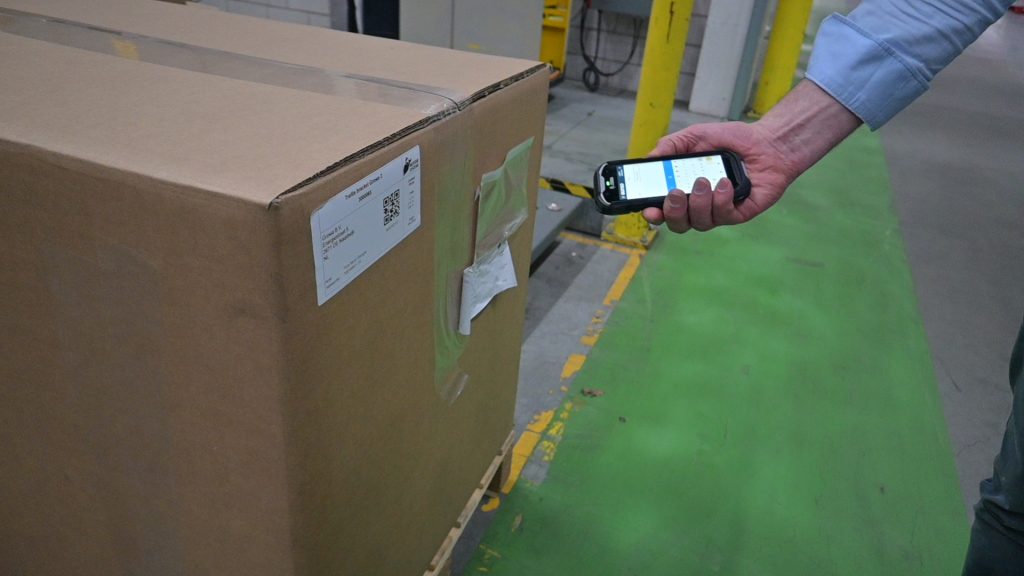
A distinction is made between automatic and manual assembly with corresponding labor steps. The weight per package is calculated based on the selected product configuration. Pallets can be constructed with yield from multiple production orders. In addition, there is integration with QSCAN.
Slit (with planned go-live in H1 2026)
Here it will be possible to process multiple active orders with multiple returns simultaneously. In addition, life-time tracking of vendor information will be set up via batch management.
More predictability and better cooperation
The entire ecosystem increases predictability and improves collaboration within the company. This allows Meteor Systems to better fulfill its promises. With each rollout, the Excel islands got smaller.
For the relatively small IT department, the solution is easily manageable thanks to management and configuration dashboards. According to Stefan Cornelisse, Director of Engineering & IT Meteor Systems, the success is not only in technology: “Time was spent in understanding the business processes, there was ownership and the will to provide an appropriate benefit to each stakeholder. The implementation was carried by the project team and the team leaders, who adopted the change with only half a day of training per department.”
Jurgen de Jong, Business Consultant at Quinso, on this project: “For me, the strength of this project lay mainly in the partnership. From the start, Meteor Systems was willing to take a critical look at its own processes, while we continuously thought along about how we could make QMES fit in as well as possible. This created not a standard implementation, but a joint solution that really adds value to the operation. This project shows what is possible when IT and operations work together. Through intensive cooperation and mutual trust, we have built step by step a scalable MES platform that fits the complexity of Meteor Systems.”
The next step
The next phase focuses on component staging and packaging replenishment.
Want to learn more about QMES and what it can do for your business? Be sure to contact us! We are always happy to assist you.